
- Shopify is a strong fit for brands that want to launch or scale without rebuilding the technical stack from scratch.
- Its main strengths remain checkout performance, multichannel selling, POS, and the app ecosystem.
- Its main tradeoffs are total cost, app dependency, and less flexibility than a heavily customized stack.
2025 GUIDE
Shopify review 2025: features, pricing, alternatives & use cases
In 2025, Shopify remains one of the most complete ecommerce platforms: a high-converting checkout (Shop Pay), multichannel sales, native POS, B2B, and built-in AI. This guide helps you decide if it fits your project—and how to start the right way.
· updated · ~ 12–15 min read
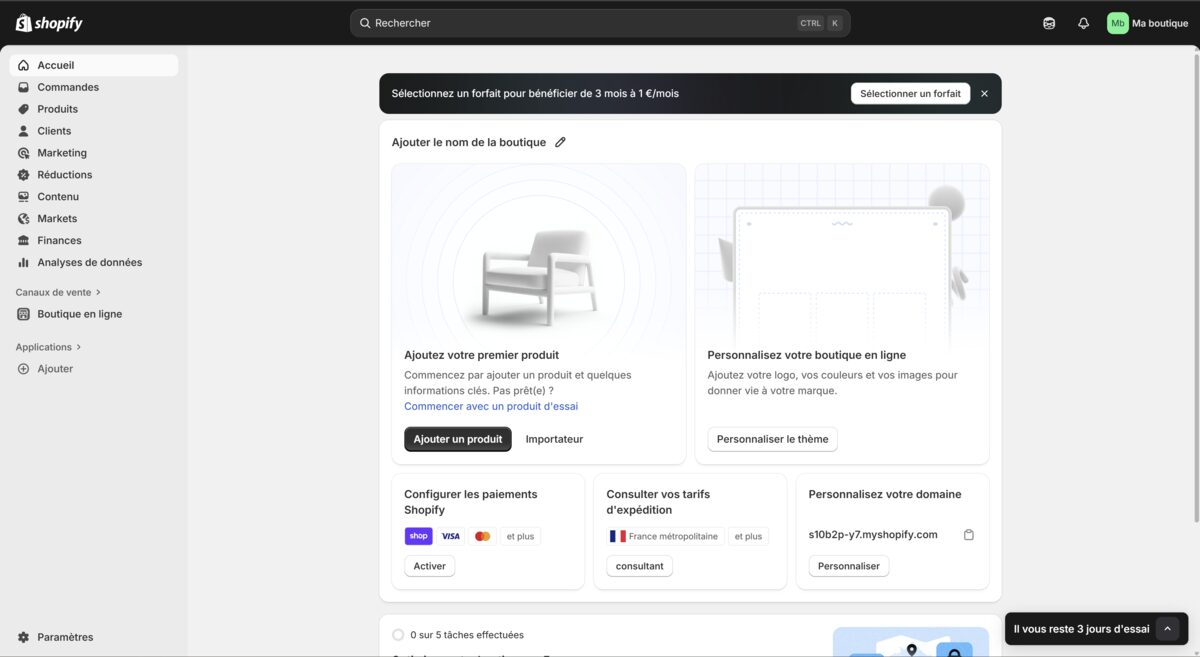
1) What is Shopify in 2025?
Shopify is a SaaS platform to build, manage and grow an online store and a physical retail presence. In 2025, Shopify emphasizes a unified commerce stack: one back office for website, social sales, marketplaces, POS, internationalization and operations (inventory, orders, taxes). The promise: sell everywhere your customers are while keeping central control. See the official
Sales channels
page.
Two pillars stand out:
Shopify Magic (AI): an integrated suite of AI-powered tools to draft copy, generate visuals, and accelerate admin tasks.
Official documentation
.
2025 Editions: Shopify’s periodic “Editions” showcase updates across checkout, design, POS, and dev tooling. The Summer 2025 Edition highlights a unified Polaris UI, headless Hydrogen improvements, and POS enhancements.
Editions Summer 2025
and the
retail blog summary
.
Also, AI Store Builder (unveiled in spring 2025) can generate store drafts from prompts to speed up initial setup (press coverage in May 2025).
2) Pricing & plans
Shopify offers several tiers to match your stage:
Basic: to get started (all core features).
Grow: to scale (more features, advanced reports).
Advanced: for larger operations (advanced shipping and reporting).
Shopify Plus: enterprise-grade (high volume, native B2B, advanced checkout customization).
Prices vary by country and commitment (monthly vs annual). Shopify often promotes a “$1/month for 3 months” after a free start. Check the official
Plans & Pricing
page for your region.
For Shopify Plus, the official site indicates starting points around $2,300/month (3-year term) or $2,500 (1-year), with variable platform fees for complex setups—see
Plus pricing
for details.
Heads-up: card fees and certain per-transaction charges (e.g., specific internationalization services run by Shopify) depend on country and usage. For cross-border sales, review the official
International pricing
.
3) Key features (2025)
Optimized checkout: Shopify cites higher conversion vs other solutions, bolstered by Shop Pay. See
Checkout
and the
Shop Pay blog post
.
Multichannel: connect Instagram, TikTok, Google, marketplaces and retail from the same back office.
Sales channels
.
Native Shopify POS: fast checkout, unified inventory across online/offline, customer profiles, staff roles.
POS features
.
Built-in AI (Shopify Magic): content generation, assistance, productivity.
Shopify Magic docs
.
B2B on Plus: customer-specific pricing, catalogs, terms, checkout customization.
B2B docs
.
Apps ecosystem: thousands of vetted integrations for SEO, marketing, logistics, and more.
Shopify App Store
.
4) Concrete use cases
DNVBs & emerging brands
The visual editor, modern themes and no-code apps let you iterate quickly and validate offers. Social channels, Shop Pay Links and subscriptions help build recurring revenue.
Omnichannel retail
With Shopify POS, you can take in-store payments while syncing inventory & customers with ecommerce. Loyalty, returns and exchanges align across channels.
International
Market-specific domains, localized catalogs, multi-currency pricing, and duty/tax estimation. Note that some cross-border features carry per-transaction fees—see the official international page.
B2B & enterprise
On Shopify Plus, B2B on Shopify supports price lists, customer catalogs, terms and delivery windows for “company” accounts.
5) In-store selling (POS) & omnichannel
Shopify POS provides fast checkout, integrated payments (by country), mobile hardware, unified inventory and customer profiles with history. Role-based permissions help govern staff actions.
POS features
.
The Summer 2025 Edition details retail upgrades: POS v10, pickup & shipping options, branded checkout styling and multi-entity support.
Retail summary
.
Pro tip: if you use another POS today, verify hardware compatibility and workflows (barcodes, discounts, returns) before migrating.
6) International, currencies & taxes
Cross-border commerce requires handling currencies, taxes, duties and logistics. Shopify provides tools to show localized prices, collect the right taxes and estimate import duties. Some Shopify-run services charge per transaction. Review the current conditions on the official page:
International pricing
.
7) Payments & Shop Pay
Shopify Payments (available in a list of supported countries) streamlines card processing and unlocks Shop Pay, Shopify’s accelerated checkout. Confirm your country’s eligibility and KYC requirements in the docs:
Supported countries
.
Shopify highlights conversion gains from its checkout and Shop Pay, citing third-party research: see
Checkout
and
Shop Pay
.
8) SEO, performance & security
Shopify runs on managed infrastructure: hosting, CDN, SSL, updates and PCI compliance are included. For SEO, you get clean URLs, sitemaps, meta fields and fine-grained control via themes and apps (tags, structured data). Performance depends on theme quality, images and third-party scripts: prefer optimized media (WebP/AVIF), a lightweight theme and minimal external JS.
In 2025 Editions, Shopify continues iterating across checkout, AI and design (Polaris), which generally speeds up implementation and improves UX.
Shopify Editions
.
9) Alternatives to Shopify
| Platform | Positioning | Strengths | Watch-outs | Best for |
|---|---|---|---|---|
WooCommerce (WordPress) | Flexible, open-source | Full control, modular hosting costs, vast ecosystem | Maintenance & security on you, plugin sprawl, variable performance | Tech-savvy teams, content-led sites + commerce |
| BigCommerce | SaaS for large catalogs | Rich native features, strong B2B | Smaller apps ecosystem, learning curve | Large catalogs, B2B/B2C |
| Wix | Simple builder, design focus | Intuitive editor, many templates | Less flexible for complex cases | Small businesses seeking simplicity |
| Squarespace | Design & creators | Beautiful themes, storytelling | Limits for advanced commerce | Brands centered on content/portfolio |
In short, Shopify shines when you need a robust, multichannel, growth-ready platform with a top-tier checkout and integrated POS for true omnichannel.
10) How to get started step-by-step
Create your account via the free trial (
Shopify free trial
).
Pick a theme that’s fast, responsive and well-reviewed. Test performance with optimized images.
Add products (compressed photos, variants, structured attributes), configure collections and onsite search.
Enable sales channels that matter: social, Google, marketplaces, and POS if you have a store.
Sales channels
.
Set up payments (check
Shopify Payments
eligibility) and taxes.
Customize checkout (policies, compatible upsells, shipping options), and enable Shop Pay.
Implement analytics (GA4 under consent, Shopify reports) and your pixels (with a compliant CMP).
Automate with apps/flows for email, retention, inventory and attribution.
Test end-to-end from cart to payment, validate margins (fees, shipping, apps), then go live.
Pro tip: plan translations, market-specific URLs and structured metadata (titles, descriptions, JSON-LD) early to avoid SEO debt.
11) FAQ
How much does Shopify cost in 2025?
Basic/Grow/Advanced pricing and fees depend on country and commitment. Check the
Pricing
page for your region. Shopify Plus publishes indicative monthly starting points—see
Plus pricing
.
Is Shopify good for B2B?
Yes, via B2B on Shopify included with Shopify Plus: company accounts, price lists, catalogs, terms and checkout customization. See the
B2B docs
.
Can I sell in-store and online with one inventory?
Yes—this is a strength of Shopify POS: unified inventory, customer profiles and permissions. See
POS features
.
Does Shopify include AI?
Yes. Shopify Magic and features highlighted in 2025 Editions (including in Hydrogen) help speed setup and operations. Docs:
Shopify Magic
&
Editions
.
Which payment methods are available?
Shopify Payments (by country) with Shop Pay, plus many third-party gateways. Check eligibility:
Supported countries
.
Ready to launch your store?
FAQ
Is Shopify a good choice for starting an ecommerce business?
Yes, especially if you want hosting, payments, checkout, and core back-office features ready from day one. The main discipline is keeping the stack lean so apps do not erode margin and speed.
Is Shopify expensive in 2025?
The entry plan is manageable, but the real cost depends on apps, payment fees, and customization. You should assess total cost of ownership, not only the monthly subscription.
Is Shopify good for SEO?
Yes, if you actively work on theme performance, collection architecture, content, and internal links. Shopify gives you a solid technical base, but it does not replace an SEO strategy.
When should you consider an alternative to Shopify?
If you need a highly customized architecture, deeper technical control, or complex requirements that do not fit your plan level, another platform may be more appropriate.